By now, you’ve surely heard about the NCAA moving to an age-based collegiate eligibility model, where college athletes generally have five years to play out five seasons of eligibility.
In doing so, they have eliminated redshirts entirely which, at least upon first hearing it, felt a little odd, as much for the nostalgia of it as the operational effectiveness.
But the more I think about it, the more I get this one.

Just like I get the NCAA ridding itself of the waiver headache. Thank goodness that one’s gone. I’m not sure I could handle any more obvious waiver requests getting denied let alone the inconsistency of those rulings year after year after year.
OK. Back to the redshirt thing.
Like most of the recent rulings — from NIL to the transfer portal to rev share and more — this is no small move. And it eliminates what has always been a huge part of the fabric of college sports.
Granted, even the redshirt rules have changed and evolved over the years. Some of the tweaks made perfect sense and others less so. But the fact that there was always the option to redshirt seemed right at the least and was so college sports at its core.
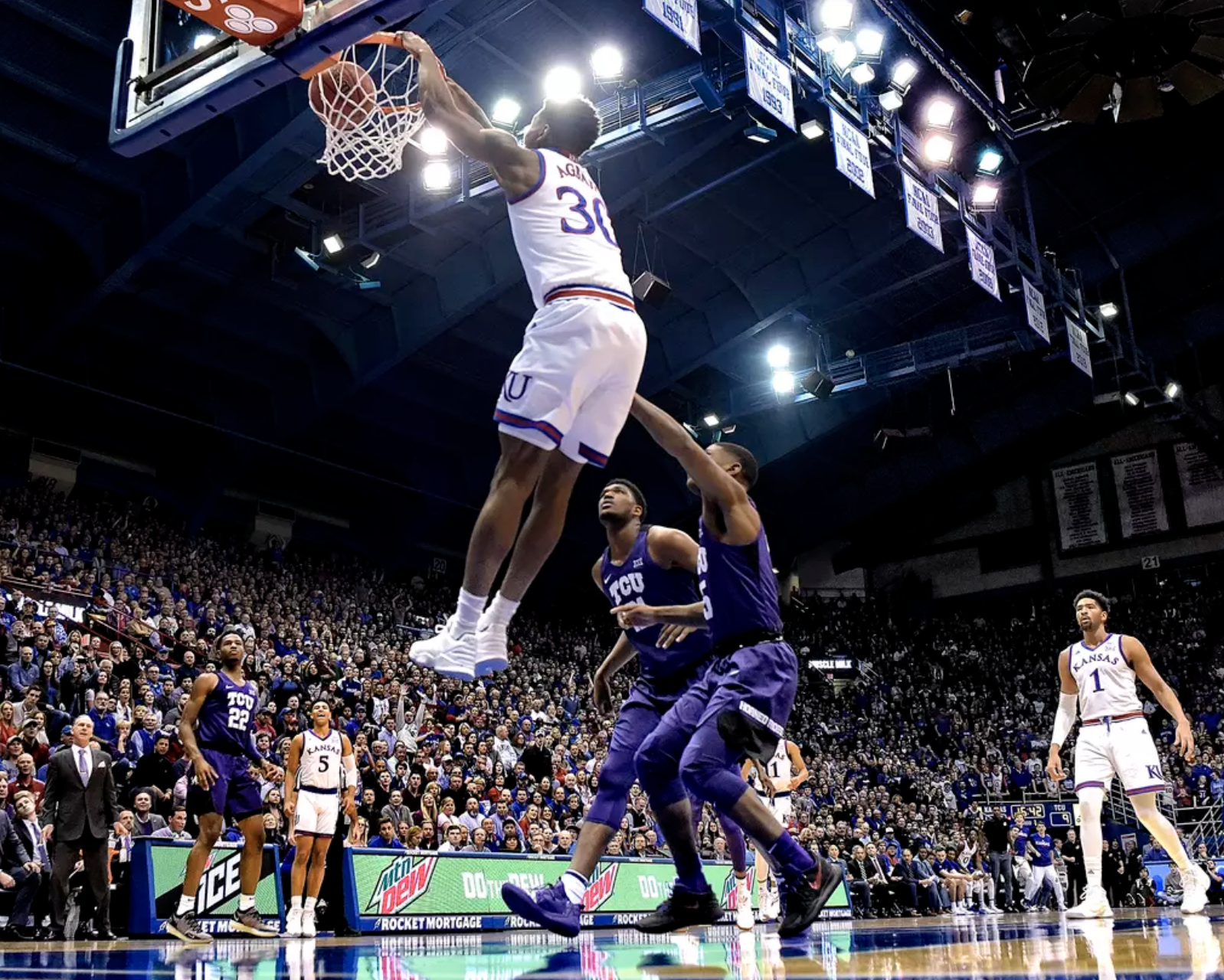
Whenever I think about redshirts, my mind always goes first to former KU hoops great Ochai Agbaji.
Remember, Ochai, a late-bloomer out of Oak Park High School in Kansas City, Missouri, was planning to redshirt his first season at KU (2018-19) until a series of injuries inspired KU coach Bill Self to pull the redshirt mid-season, thus jumpstarting a journey that began out of necessity and ended with a national championship.

Images of Ochai Agbaji from his first game as a Jayhawk during the 2018-19 season. [Kansas Athletics photos]
Ochai was a perfect redshirt candidate. And both he and his family were more than willing to let things play out that way. They understood it. They realized it was for the greater good of his career. They saw that it essentially gave him five years of both school and basketball at Kansas and that, at the time, seemed like the best thing for his future.
Now, everyone gets that. And, if you’re lucky and school is where you want to be, you’ll get to play all five years. Pretty cool.
It won’t change anything for the ones who aren’t ready. They still have that buffer year to get bigger, stronger, smarter or whatever else they need.
Remember, in so many instances these were 17 and 18-year-old kids coming to college, looking to grow both physically and emotionally. Some of them have been ready to roll right away. We’ve seen plenty of instances of that over the years, with some pretty memorable ones in recent years. But others, be it body-wise or in their minds, absolutely needed more time to grow before they were ready to compete at the college level.
For that reason — for athletes and coaches alike — the redshirt option was always absolutely perfect.
These days, though, the whole vibe has changed. Sometimes by design and sometimes as an unintended consequence of the bigger, better, faster, stronger movement.
No more redshirts means no more bonus development years. But, before we get too upset about how that has been taken away, let’s make sure to realize that these new rules basically give everyone a redshirt year.
If you need it — physically, mentally or even in the event of an injury — great. You’ll be in school for five years, you’ll have the opportunity to play all five if you’re ready and if you’re not you can still use that first year or two to grow and mature. Think about that for a second — you could essentially sit for two years and still have three years of eligibility remaining.
If you don’t end up using it, you probably weren’t going to need it anyway.
As has been discussed and documented, there aren’t a ton of 4-year guys grinding it out from freshman to senior year anymore and I don’t think the tide is turning back anytime soon.
No one wants to sit anymore, so we probably won’t see a ton of instances like that. Especially with the transfer portal being what it is, both as an entity and an option.
If anything, eliminating redshirts now will give college coaches the opportunity to treat these guys even more like pros. You’re either ready or you’re not. While it might not be as cut and dry as that in college basketball — minutes will still be handed out to the players who deserve them and there are fewer minutes to be spread out among fewer players — it probably will matter quite a bit in college football and a few other sports.
Guys who come in prepared to sit behind veterans at running back, wideout, in the secondary and at linebacker may now find themselves inheriting important full-time jobs on special teams, in mop-up duty or early in the season against non-conference foes.
In that way, this change can be good for everybody.
But it still will make college sports as we once knew them look and feel a little different. Yet again. Anyone seeing a pattern here?
In the case of Agbaji, if there weren’t redshirts back then, maybe he would’ve been more of a factor in KU’s early-season plans. But he still would’ve received limited run and may even have suffered as a result of it, by getting in for just 5-10 minutes a game (max!) earlier in his career. Once he jumped in full-bore in mid-January, Agbaji played less than 21 minutes in a game just three times in 22 appearances, including 16 starts.
What if he had a couple of bad outings early on and his confidence took a hit? That might have delayed his ability to be ready by the time the Jayhawks pulled the redshirt and actually needed him.
With a guy like Agbaji, who was incredibly driven and had the kind of work ethic coaches are looking for, it probably was always going to work out. But it might have looked a little different had he just been thrown into the fire right away.
We’ve certainly seen more highly touted freshmen than him struggle early in their careers and never recover, though. So I wouldn’t be surprised if coaches still keep the redshirt model in their minds while building their rosters and handing out playing time.
The good news here, though, is that in those games when free PT is available — because of a blowout or an overmatched opponent, etc. — those seldom-used guys and girls now will be able to get some valuable experience without it hurting their eligibility. No matter how little that is, seeing the floor, getting into a game and getting to actually feel and experience figures to be a major bonus for every athlete’s future.
Maybe this is a good thing. Maybe it’s not. Maybe it works out for some and doesn’t work for others. That’s the world we live in now, and you either get on board or get left behind.
Having a fifth year to play whatever sport you’re talking about certainly seems like it should be a good thing for most college athletes. But there’s little denying that, at least initially, it will change the dynamic for many athletes and make things look a little different than they always have.
— For tickets to all KU athletic events, visit kuathletics.com